



‘Johnny Rotten wiped his nose on the curtains…’ Exclusive: the Pistols at Piccadilly in pictures.

Updated: Aug 10
The day the Sex Pistols came to Piccadilly Radio - accompanied by Malcolm McLaren, Tony Wilson, Ken Dodd’s joke writer and an ex-wrestler called Abe Ginsberg.

We all know about the Sex Pistols’ famous gigs at Manchester’s Lesser Free Trade Hall in 1976. You will probably have an idea that the Pistols played at the Electric Circus in the city too. You may even have an inkling about the band supposedly appearing at Didsbury College - although they were a no-show. But what about when the Pistols came to visit Piccadilly Radio, did you know about that? No, neither did we. Until a set of photos that haven’t seen the light of day for half a century reappeared. David Nolan tracked down the people who swear they were there. Photos by Richard Lander.
RICHARD LANDER (Teenage photographer): This was at Piccadilly Radio 261 in 1976. I’d been travelling between school and university - we didn’t call it a gap year back then - and was back home for a few weeks. I was a keen photographer back then and these were taken on a Nikon SLR, a present from my parents, and developed and printed in the darkroom at Manchester Grammar School. I was 18 and was there because my sister worked at Piccadilly, starting as a receptionist then moving into promotions and later a brilliant career as a TV producer - a career she continues today.
KATIE LANDER (Piccadilly Promotions Assistant): I started as a nighttime receptionist at Piccadilly on 70p an hour. Then I moved to promotions. On my first day at Piccadilly, I had to look after David Cassidy… I thought I’d died and gone to heaven. We had to get big names; we had to get press. Punk just wasn’t on my radar. Piccadilly was quite Radio 2-ish. But punk was just bubbling up in Manchester.
TONY INGHAM (Piccadilly Promotions Manager): We weren’t playing punk. We never really did. It was ABBA. And Elton John. In 1976 you weren’t going to win an audience by playing punk on Piccadilly Radio. You just weren’t. I don’t think punk was made for commercial radio. When the Pistols were interviewed, we won the Eurovision Song Contest with ‘Save Your Kisses for Me’ by Brotherhood of Man. That puts it into context.
RICHARD LANDER: As to the photographs; it’s Roger Finnigan on the decks so the Pistols were obviously on his show.
KATIE LANDER: I was probably going out with Roger at the time…
ROGER FINNIGAN (Piccadilly Head of Features): The hype and build up leading up to the interview was tumultuous. The red tops had gone to town with headlines like ‘The Filth and the Fury’. Malcolm McLaren must have loved it.
TONY INGHAM: They’d done the Bill Grundy interview about a week before (The Pistols had sworn on live TV). They’d barely put any music out, so they were famous for the Bill Grundy thing. They were at Piccadilly for shock rather than music ability. We told the Radio Authority that they were coming in. We used to push the barriers back when it came to the guidelines; we were quite a risqué, cocky radio station. The Radio Authority said you cannot put this out live and I don’t think we argued with them. In those days if you got three formal warnings you could lose your licence.
RICHARD LANDER: The Pistols all look pretty pissed off and surly – part of their branding. The bearded man in the hat is an ex-wrestler by the name of Abe Ginsberg.
TONY INGHAM: We had really good relationships with the national newspapers who all had offices in Manchester. Four or five of them asked if they could come in and listen.
ROGER FINNIGAN: The studio next door to where the interview was taking place was crammed with sweating journos just waiting for Round Two of the Grundy confrontation. Maybe that was why I got Abe Ginsberg in as my co-presenter… for protection in case of a scrap! In fact, Abe and I broadcast together regularly and he knew the ropes.
KATIE LANDER: Abe was a wrestler and he was very friendly with Roger. He used to do the chat on the show and he was very smart. A really good broadcaster.
ROGER FINNIGAN: I think these photos were taken during the setting up of the interview in the studio when a lot of people were milling around trying to get a look at the band. That’s Dave Dutton with the sideburns and moustache sat just to the left of my head, a local comedian from Atherton. He was a regular on-air contributor.

DAVE DUTTON (Comedy Writer): I was a reporter on the Manchester Evening News. Then I started writing comedy. I wrote for Ken Dodd. I was his main writer for about seven years. Two Ronnies, Dick Emery, the main ones of the time. Then I did some freelancing at Piccadilly - some interviews, some presentation. Not full time, but I was in quite a lot. It was good fun.
ROGER FINNIGAN: I see from the pictures that Tony Wilson was present, who of course went on to become a music luminary.
PATRICIA BROOME (Piccadilly Radio receptionist): I don't remember seeing Tony Wilson or Roger Finnigan. But maybe I was too traumatised to notice!
TONY INGHAM: We wouldn’t have allowed Tony Wilson in the studio. Because of what he was like he would have started talking. He would have put his two penneth in.
RICHARD LANDER: Tony Wilson was developing his relationship with the Sex Pistols after their appearance on So It Goes, his new arts magazine programme on Granada TV which was a spinoff from his Friday What’s On slot on (regional news show) Granada Reports. One of the photos features Tony Wilson and my sister Katie.

KATIE LANDER: There’s a photo of me and Tony Wilson? I don’t remember that. You’d better send it to me. (We do). Oh, that’s hilarious. Tony was a big deal. He was doing Granada Reports every night, so he had his shirt, jacket and tie on, but under the desk he had his jeans on. There were two Tony Wilson’s. There was this really good TV presenter and news journalist and then there was the music enthusiast - and they were like different people. I went to all the recordings of So It Goes. That was really, really exciting.
RICHARD LANDER: Tony Wilson was a great friend of the family, having met my brother at Cambridge. He would stop in at our home in Didsbury after the show on Friday on his way home to Glossop. He had a lovely bromance with my Russian-born grandfather who came to us for Friday night supper every fortnight, still possessing the same heavy accent he had when he came here in 1910. He would tease Tony that his show had been rubbish that evening. We were all shattered when Tony died at such a young age.
KATIE LANDER: Later, I remember going down to Granada TV and thinking… this is wonderful. I’d never be able to work in a place like this. Tony Wilson was quite inspirational really.
PATRICIA BROOME: My encounter with the Sex Pistols happened when I was just going in for my shift along that dark and dingy arcade at Piccadilly Plaza. These menacing looking guys were approaching in the opposite direction. They looked quite scruffy and really scary, and one of them was holding a long scarf and wringing it with both hands. I thought he was going to strangle me! My imagination was working overtime at that point, so I ran up the escalator and buzzed security to let me in. The scary guys then followed me and were met in the reception. They probably didn't realise how scared I was. Horrible experience. But now I can see the funny side.
DAVE DUTTON: Malcolm McLaren was there in his long, furry coat. Like the one Ken Dodd used to wear. Like a ringmaster, overseeing everything.

TONY INGHAM: Obviously, it was recorded. We’ve recently archived all the tapes we could find… under beds, in attics and everything. And they’re all now being digitised in Manchester Central Library. But this tape isn’t there. Why? Well, tape was expensive. We used to re-use tapes all the time. Plus, it wasn’t a startling interview. They didn’t swear, they were just Jack the Lads farting about. It wasn’t one where you would have thought… ooh, we’d better keep that.
DAVE DUTTON: There was a sense that the Pistols were advocating violence. In their own way. Like, a kind of harmless violence, if I can put it that way. A lot of spitting at people. So, Abe said, when they come in, we’ll sit chatting to them, then halfway through I’m going to put Johnny Rotten in a headlock. And say, how do you like it, then? All this violence and stuff. We were all keyed up. The Pistols came in and we were sat round the table all agog. They were big news, the Pistols. This would have been even bigger news that this had happened to them in Manchester.
ROGER FINNIGAN: As for the interview itself… Well to be honest it was a bit of damp squib. The Pistols were on their very best behaviour, including (Pistols’ guitarist) Steve Jones, who had really got stuck into Bill Grundy. So, the Pistols were funny, mischievous and raw but never up for a fight. My memory is they just were a handy bunch of lads.
TONY INGHAM: There were curtains in the studios. Johnny Rotten had a runny nose, He was leaning back in his chair, the curtains were within arm’s reach, and he just wiped his nose on them. I remember thinking… oh for fuck’s sake. That was my abiding memory: Johnny Rotten wiped his nose on the curtains.
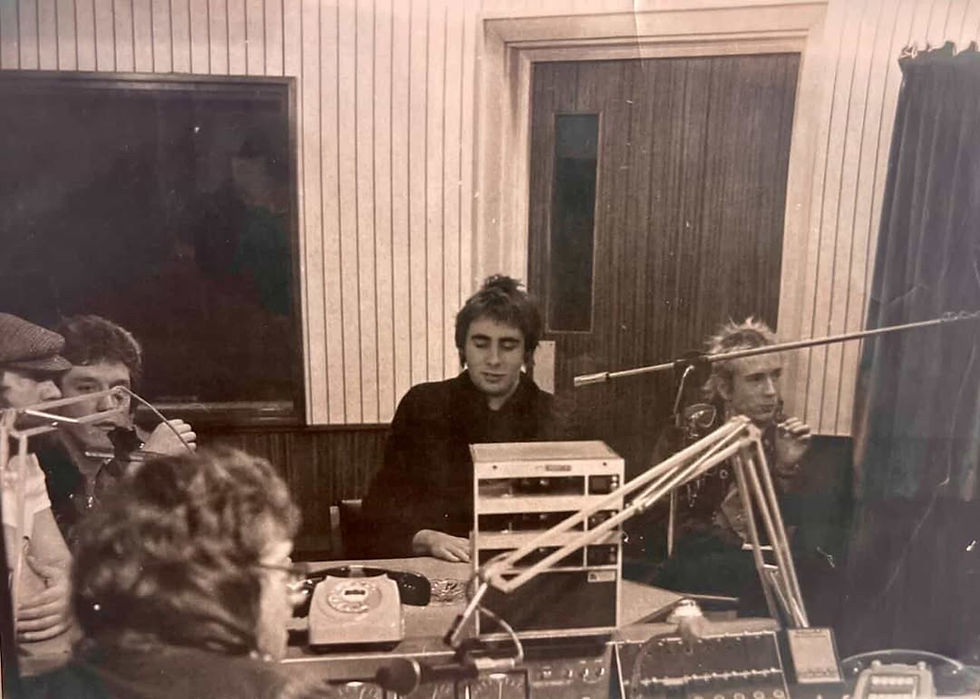
DAVE DUTTON: The interview went on and we’re waiting for Abe, and then… nothing. The interview finished and we were all looking at Abe. We said, what happened, why didn’t you do it? Why didn’t you get him in a headlock? Abe said, I was going to then I realised that they’re in the same business as me. Showbusiness. That’s all they’re doing. It’s showbusiness. I didn’t have the heart to do it. We were all a bit disappointed really.
KATIE LANDER: Punk? I got it. I’ll tell you what I do remember about that time… The music was so safe, and the record companies were so big – CBS, EMI – they had so much control over everything. It was ripe for revolution.
ROGER FINNIGAN: I came to love their classic Never Mind the Bollocks album. But at the time of the interview you must remember we were playing the Bay City Rollers, although to be fair we were also playing 10cc and Steely Dan. So, the Pistols music was like jumping into a cold shower in that deep and dark December. I remember thinking… I have to try and understand this. I think I recall going to a Damned gig in a rough-arsed Manchester club and found myself virtually alone there. There must have been about 30 people.
DAVE DUTTON: I enjoyed punk music. The energy. It never loses its appeal. Pete Shelley (Buzzcocks) went to the same school as me. ‘Ever Fallen in Love…’. You never get sick of hearing it. It’s still a bloody good tune.
TONY INGHAM: As a genre punk changed the world. But punk in itself wasn’t for me. I look back on it more fondly now than I did at the time.
PATRICIA BROOME: Did I like the Sex Pistols’ music? Absolutely not!
ROGER FINNIGAN: Although I now feel privileged to have met the Pistols that day, I never thought I’d be saying that 50 years later. I’ve passed many of my vinyl albums from the 70s onto my son. I’m pleased that his generation - he’s 27, one year older than I was when I met the Pistols - have really taken to playing vinyl again. I must sound ancient, which I suppose I am. But I still like to ride motorbikes. I just wish I still had that brown leather jacket in the photographs.
Where are they now?
Peter Abel Ginsberg - known as Abe - died in 2001. As well as wrestling and broadcasting, he dabbled in acting and was a successful antiques dealer and property developer.
Tony Wilson died in 2007. There’s now a bit of Manchester named after him: Tony Wilson Place.
Professional provocateur and Pistols’ manager Malcolm McLaren died in 2010.
Sex Pistols - minus Johnny Rotten/John Lydon - are still touring with Frank Carter on vocals.
Patricia Broome is now retired after decades as a radio station receptionist. She’s since written a book about her experiences called Auntie Pat - A Face for Radio.
Richard Lander is now, ‘winding up a long career in financial news.’
As well as comedy writing, Dave Dutton got into acting, appearing in 11 different roles in Coronation Street and five in Emmerdale. He wrote a book about his life called The Thirty Bob Kid.
Katie Lander… well, it turned out that she could work in a place like Granada TV. She’s the BAFTA award-winning TV producer behind shows like Bank of Dave and Davina McCall’s Channel 4 films on the menopause. She also put Jonathan Ross on TV for the first time.
Tony Ingham went on to become Piccadilly’s programme controller and co-wrote a book about the history of the station called For the Record. ‘I’m 74, retired, and still dining out on my story about Johnny Rotten’s snotty curtains.’
Roger Finnigan went on to have a long career in TV documentaries. ‘But I have to say, I loved my radio days best of all.’
The audio recording of the Pistols at Piccadilly appears to have been lost; but maybe there’s a Cult Manchester reader out there who has a cassette of it sitting in the back of a drawer? Get in touch if you find it.


